
A European Classroom: Reflections on the UEFA Pro Licence Journey
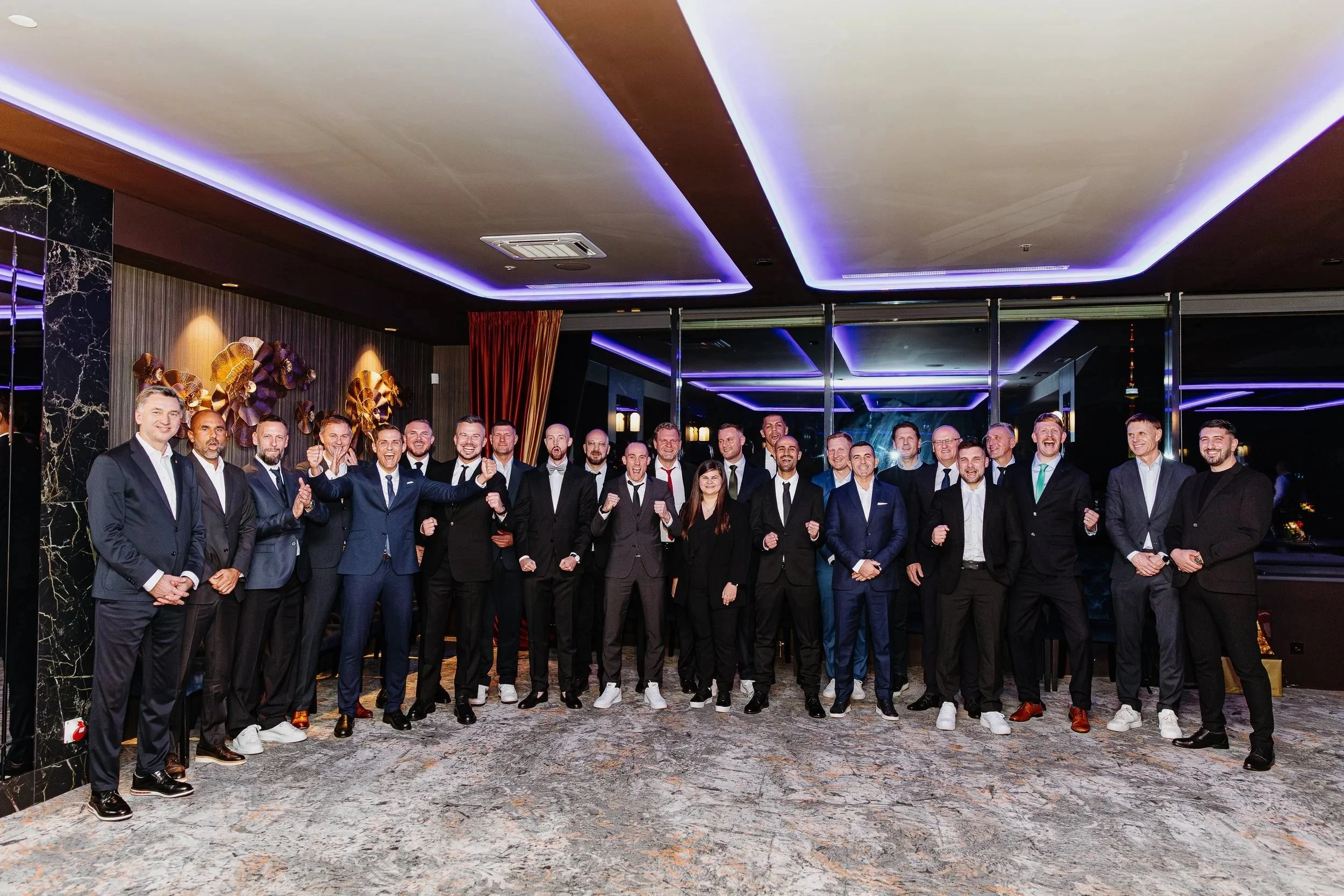
The UEFA Pro Licence graduating group in Vilnius, Lithuania, bringing together 20 coaches from nine different nationalities at the conclusion of the programme.
An international learning environment
Zurab Amirian has completed the UEFA Pro Licence, the highest formal qualification in European football coaching. The achievement marks the end of a demanding and immersive journey that went far beyond the technical requirements of the course. What defined the experience most was not only the content, but the people, the culture, and the environment in which learning took place.
The programme brought together 20 coaches from nine different countries: Italy, Germany, Finland, Poland, Portugal, Belgium, Switzerland, Lithuania, and Serbia. That diversity quickly became one of the course’s defining features. Different football cultures, professional backgrounds, and personal experiences consistently challenged assumptions and broadened perspectives, both on and off the pitch.
A culture built on trust and honesty
From the outset, expectations were clearly set by Daniel Wimmer, Head of Coach Education at the Lithuanian Football Federation. At the opening of the course, he emphasised the importance of psychological safety and honesty within the group. The agreement was simple and uncompromising: feedback had to be open and sincere, whether positive or critical, without becoming personal, and what was shared within the group would remain there.
That principle shaped the entire learning environment. It allowed coaches to speak freely, to confront difficult topics, and to reflect deeply on their own behaviour and leadership. The result was a space where direct conversations were not only possible, but encouraged. The dynamic energy in the room was unmistakable, fuelled by contrasting viewpoints and cultural perspectives that often extended beyond football into broader questions about leadership, responsibility, and life.
Over time, the group evolved into more than a cohort. It became a close network. Every two months, participants travelled to Lithuania for intensive week long modules, with full days running from early morning until early evening, followed by assignments that frequently stretched late into the night. Careers continued to move in parallel with the course. Some coaches lost their jobs, others found new opportunities, and support within the group was constant. The journey was demanding and, at times, uncomfortable, but it was never superficial.
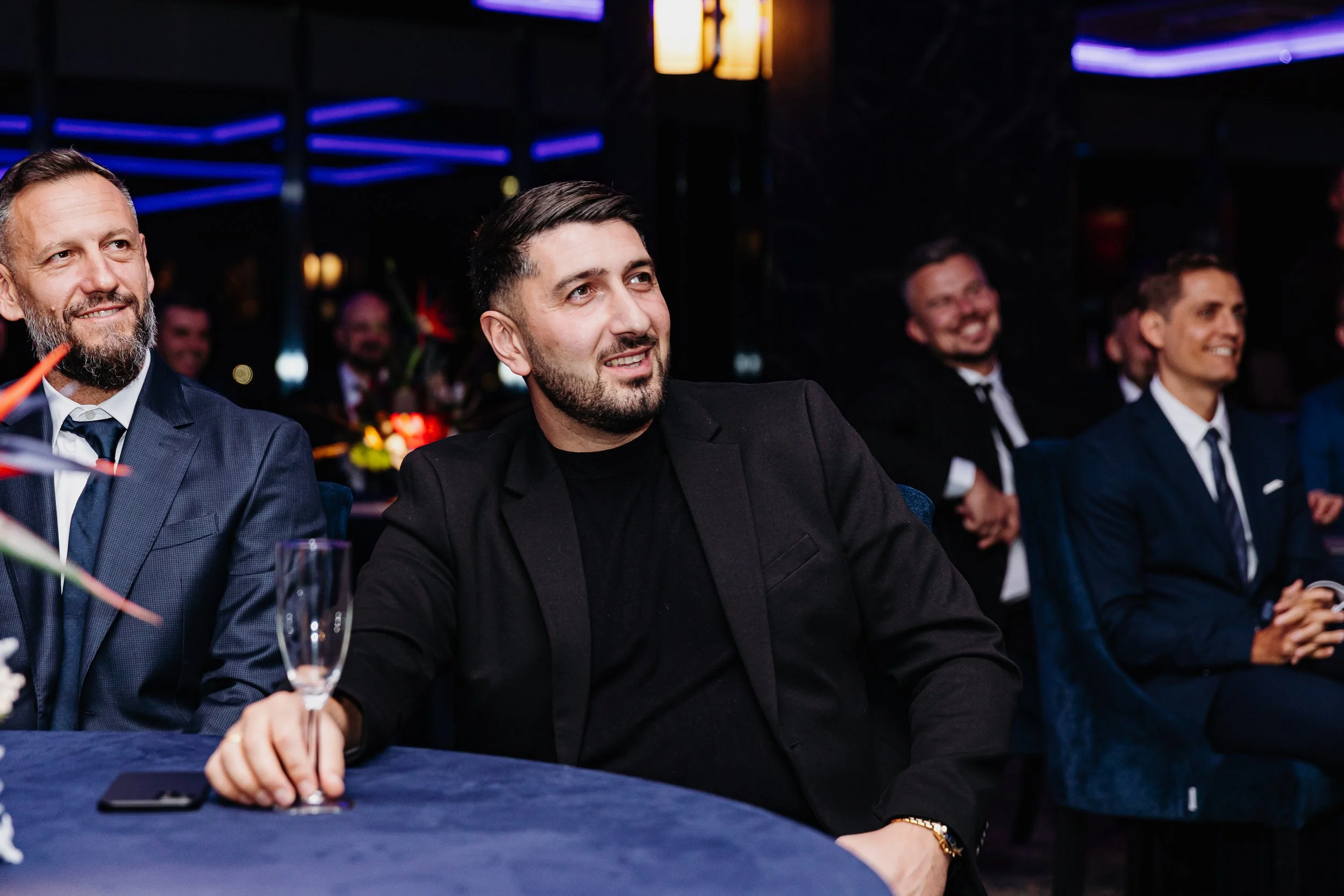
Aleksandar Stojmirovic and Zurab Amirian pictured together during the UEFA Pro Licence graduation ceremony.
Learning from experts
The overall quality of the programme was consistently high. The content was carefully structured, and external experts were invited based on their specific expertise and relevance to each module.
One of the highlights was the tactical video analysis module, led by experienced Bundesliga analysts Niklas Lanwher and Simon Falke. They shared practical insights from their work, using examples from top level competitions such as the Bundesliga and the Champions League. The focus was not only on analysis itself, but on how information is filtered, interpreted, and communicated within elite environments.
The media and communication module offered a different but essential perspective. Over four days, the focus moved away from tactics and towards communication, image, and trust. Coaches explored how messages are received by players, supporters, and the public. These sessions were led by Jordan Foster, Raphael Honigstein, and Henry Winter, all journalists with long standing experience in international football media. Their insights and real examples gave a clear picture of how modern football operates beyond the training ground.
Another standout module centred on leadership and organisational dynamics. The emphasis was on understanding individual strengths and creating staff structures that allow people to operate at their best. This part of the course was delivered by Konrad Bohner, who has extensive experience working with leaders in large international organisations, including BMW and Rolls Royce. His contribution offered a valuable perspective on how high performance cultures are built and sustained beyond the football context.
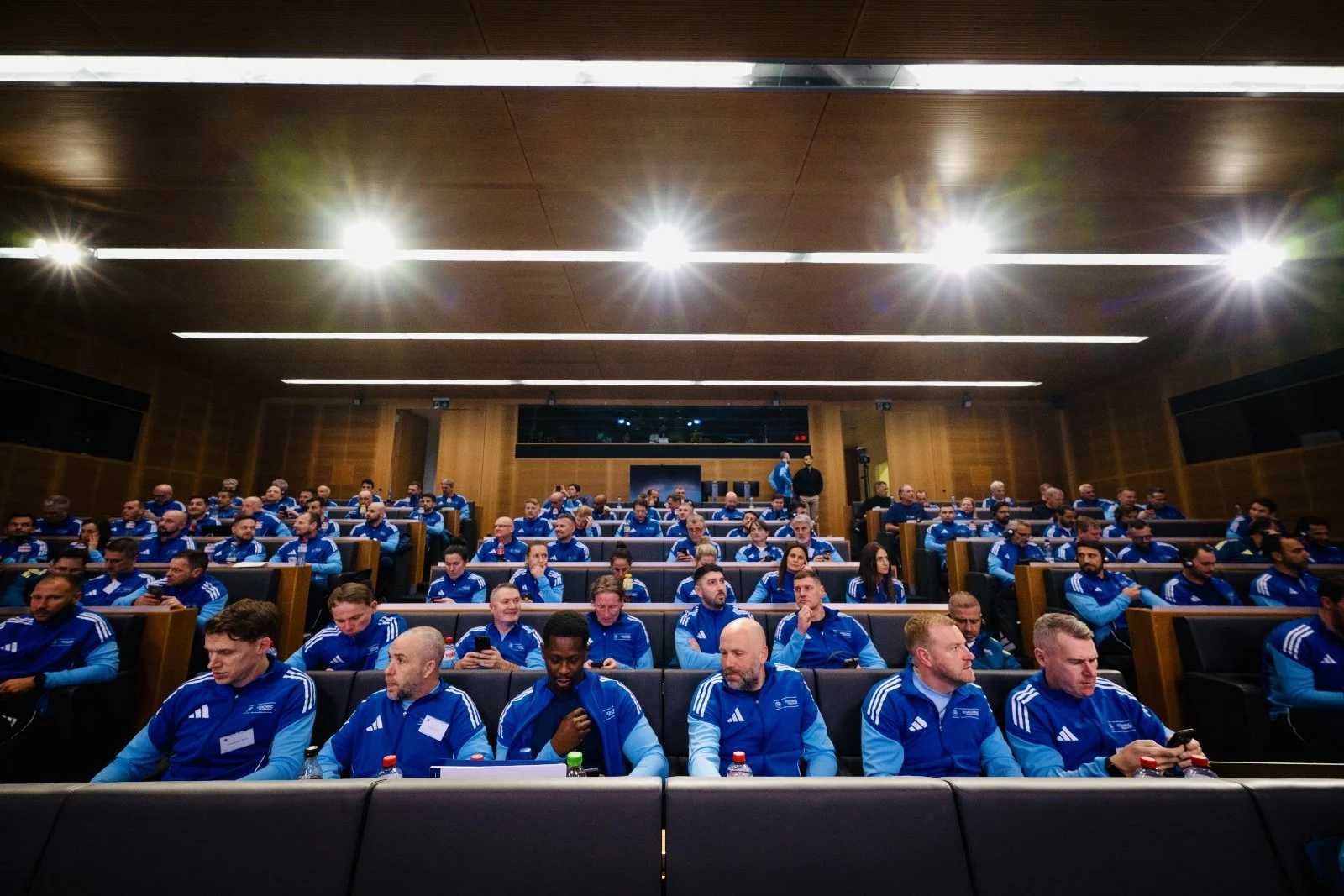
UEFA Pro Licence student exchange at UEFA headquarters in Nyon, Switzerland
Learning beyond borders
A particularly inspiring phase of the programme was the UEFA Pro Licence student exchange at UEFA headquarters in Nyon, Switzerland. Over three days, participants exchanged ideas with coaches from several national associations, including Lithuania, Croatia, Türkiye, Slovenia, and Scotland. The programme featured contributions from leading figures such as Rafa Benítez, who spoke about creating high performance environments, Lluís Cortés Cava on leadership and resilience, Andy Cale on well being in elite sport, and Professor Sergio Lara Bercial on coach development and learning cultures. The exchange reinforced the value of international collaboration and shared learning at the highest level.
A moment of reflection
The graduation moment itself offered a chance to pause. Receiving the UEFA Pro Licence diploma was not only about the certificate, but about acknowledging the journey behind it. The long days, difficult conversations, shared challenges, and collective growth all formed part of an experience that extended far beyond formal education.
In the end, the UEFA Pro Licence proved to be much more than a course. It brought together an exceptional group of coaches from across Europe, each with a distinct story and perspective. They challenged one another, supported one another, and grew together. The result was not only a qualification, but a deeper understanding of the game, of leadership, and of the people within it.
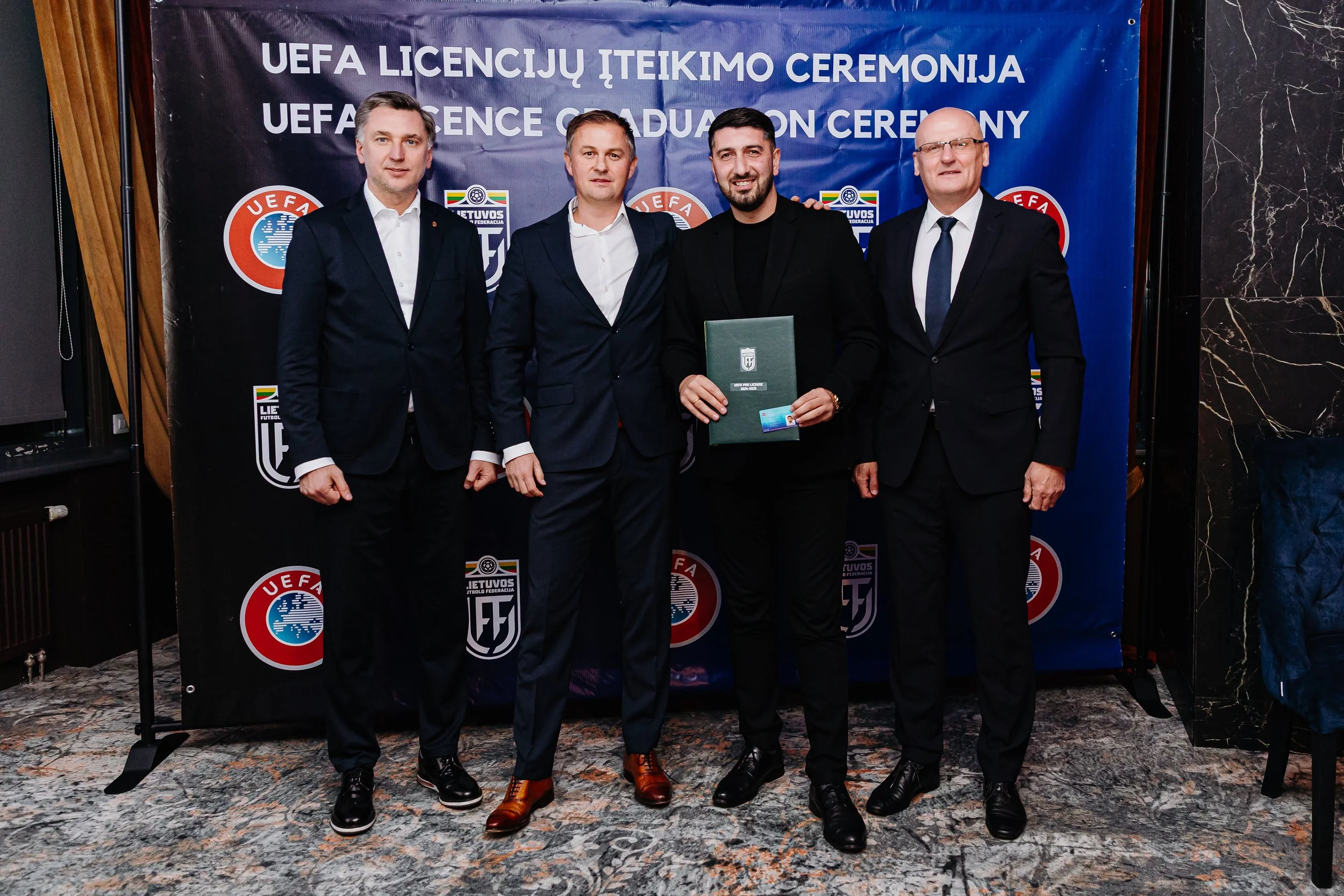
Zurab Amirian receives his UEFA Pro Licence diploma during the graduation ceremony, pictured with Deividas Šemberas, Daniel Wimmer, and Valdas Urbonas.